Applied Technology Group & Indiana Tech
Projects
Automation workflows that save real time, dashboards that surface the right data, and an AI game suite that started it all. These are the projects that define how I think about technology.
Rewst Automation
Automation & Workflow
These workflows were built in Rewst, a managed service automation platform. Each one targets a specific repetitive process — eliminating manual work, improving accuracy, and freeing engineers to focus on higher-value tasks.
Auto Dispatch — Emailed Tickets
The most complex automation in production. When a ticket arrives by email, this workflow parses the content, determines priority and category, and assigns it to the correct engineer automatically — no manual triage required.
Handles 60–100 tickets per weekTimesheet Audit
Originally built as a Python script that emailed engineers directly, this tool was later migrated to Rewst. It reviews engineer time entries, flags discrepancies, and sends targeted notifications — improving accuracy without anyone having to chase down corrections manually.
Saves ~1 hour per week in reviewsTicket Auto Escalation
When a ticket needs to move up the stack, this workflow automatically identifies the correct engineer to escalate to based on issue type and team structure. Removes ambiguity from the escalation process and ensures the right person gets the ticket immediately.
Attendance Reporter
Generates attendance reports by pulling entry log data from the company's security system. Used during performance reviews to provide a factual, timestamped record of attendance and punctuality — removing subjectivity from the process.
Time Off Report
Automatically emails each employee a personalized summary of how much vacation time they've used and when their days reset. Eliminates recurring questions to management and keeps every employee self-informed on their balance.
Grafana
Data & Visualization
Built a suite of Grafana dashboards to surface operational metrics that previously required manual investigation. These dashboards give the team real-time visibility into call queue performance and backup system health.
Queue Performance Dashboards
Three dashboards covering every angle of call queue activity:
- Individual engineer metrics within the queue
- Overall queue stats including call volume and received calls over time
- Call arrival heatmap — visualizes when calls peak by hour and day
- Missed call heatmap — shows patterns in calls that go unanswered
Backup System Dashboard
A monitoring dashboard that surfaces failed backup jobs across all managed client systems and devices. Previously, finding failed backups required manual checks across multiple systems — now they're visible at a glance.
Gives engineers an immediate starting point each morning and ensures nothing slips through unnoticed.
Side Project
Fort Wayne Businesses
A local resource for discovering businesses across Fort Wayne, IN — built and launched as a side project to support the community I live and work in.
fortwaynebusinesses.com
A directory connecting people with local businesses in Fort Wayne. Built to make it easier to find and support what the city has to offer — from restaurants and services to shops and professionals.
Visit fortwaynebusinesses.com →Personal Project
Calendar Puzzle
A daily puzzle: cover every cell on the board except today's month, day, and weekday using ten uniquely shaped pieces. Each date has multiple solutions — find one yourself or let the solver reveal them.
Pieces
Senior Project — Indiana Tech
AI Game Suite
Two classic strategy games powered by the MinMax algorithm — built as my senior project at Indiana Tech. The AI doesn't guess; it runs a recursive search algorithm that evaluates every possible future game state to find the optimal move.
Tic-Tac-Toe
MinMax Algorithm
Connect Four
Alpha-Beta Pruning
The Theory
How the AI Works
The "AI Move" button doesn't guess — it runs a search algorithm that evaluates every possible future game state to find the mathematically optimal move.
Tic-Tac-Toe
The MinMax Algorithm
MinMax is a recursive decision-making algorithm for two-player, zero-sum games. It explores the entire game tree by alternating between two roles: the Maximizer (who seeks the highest score) and the Minimizer (who seeks the lowest).
For Tic-Tac-Toe, the board is small enough that MinMax can evaluate every possible position to depth, guaranteeing a perfect move every time. The AI will never lose when playing optimally.
- Only works on purely strategic, chance-free games
- Requires exactly two players
- Guaranteed optimal play on small boards
Connect Four
Alpha-Beta Pruning
Connect Four has a much larger game tree than Tic-Tac-Toe (over 4 trillion positions), so pure MinMax is too slow. Alpha-Beta pruning is an optimization that skips branches of the tree that cannot influence the final decision.
Alpha tracks the best guaranteed score for the Maximizer; Beta tracks the best for the Minimizer. When Alpha ≥ Beta, the branch is pruned — we already know it won't be chosen.
- Alpha: highest value guaranteed for the maximizer
- Beta: lowest value guaranteed for the minimizer
- Pruning can reduce search time dramatically
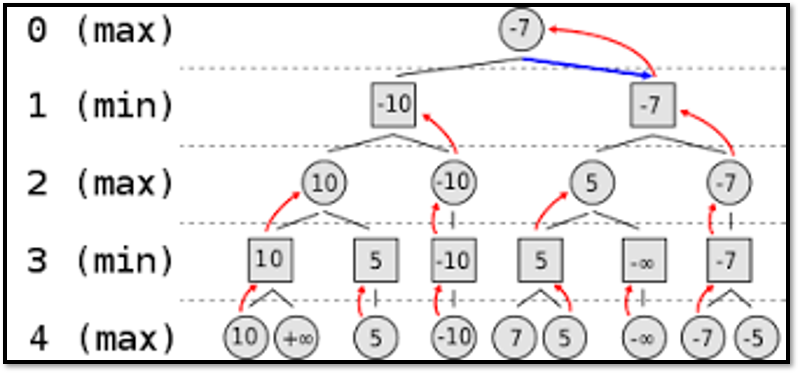
MinMax decision tree — alternating max and min levels
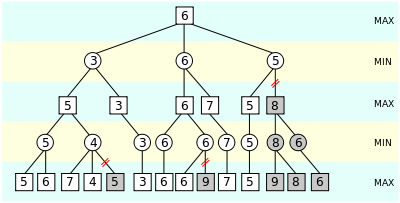
Alpha-Beta pruning — grayed branches are skipped entirely